|
Rainforest
Printer
friendly version
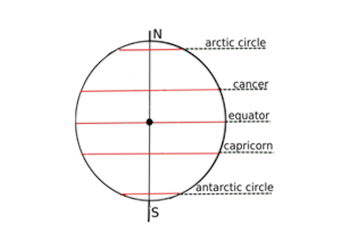
Tropical rainforests are located around the equator; from the Tropic
of Cancer in the north, to the Tropic of Capricorn in the south. 
The largest rainforests are in:
Brazil- Amazon River Basin (South America)
Zaire-Congo River Basin(Africa)
Indonesia (islands found near the Indian Ocean).
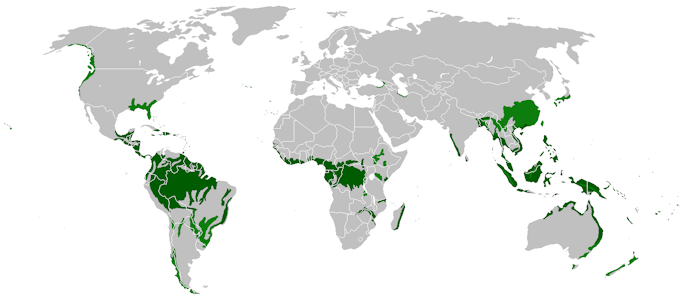
Smaller tropical rainforests are located in Central America,
Madagascar, Australia, India, Southeast Asia, Hawaii and the
Caribbean Islands. The Amazon rainforest in South America is the
world's largest, covering an area about two-thirds the size of the
continental United States.
*Art
Palm Tree
Need: newspaper ( 2 double pieces), tape, scissors
Open and lay the 2 pieces of newspaper out flat. Take sheet 1 and
begin rolling it into a tube.
When you reach the center of sheet 1, add sheet 2. Continue rolling
until both are rolled into a tube.
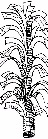
Secure the loose ends with tape. Starting at the top of the tube, cut
through all surfaces to halfway down the tube. Make 3 to 4 additional cuts.
Starting from the center, gently pull up on the paper. The leaves of
the tree will begin to grow.
Crayon Resist
Have books and pictures of rainforest species. After reading books on
the rainforest have children sketch creatures of the rainforest using
wax crayons. Have them draw their rainforest creatures and around
their creature the environment in which the creatures are
found(trees, vines, ferns, etc). Once the drawing is done paint with
black, blue, purple, or green watercolors onto the drawing and let dry.
Paper Mache' Snake
Need: metal coat hangers, newspaper, small box (size of individual
cereal boxes), masking tape, paints (various colors).
Using pliers untwist the coat hanger and straighten it as much as you
can. Have children layer the hanger with newspaper and use the
masking tape to tape it on the hanger.
Use a small box to make the snakes head. At one end of the box make a
cut in the box at the end center lengthwise to create a mouth. Place
the small box at one end and tape it to the hanger. If you do not
have a small box wod up newspaper and tape to the end to make a head.
Make a indent in the center front end of the newspaper head to create
a mouth.
Mix up flour and water to create a paste for paper mache'. Cut up
strips of newspaper. The the newspaper/hanger snake on wax paper.
Place the newspaper strips in the paste mixture and layer on the
snake. When finished taking globs of the paste mixture and smooth
over the snake. Add another layer of paper mache' the next day. Leave
to dry a few days. When dry have the children paint their snake.
Rainstick
Need: A cardboard tube (paper towels, aluminum foil or wrapping paper
tube) The longer and bigger around the better. 1 cup of dry rice,
posterboard, scissors, tape, glue.
Cut 2 strips of posterboard the same length as the cardboard tube and
about a 1/2 inch wider than the inside of the cardboard tube.
Place glue down the center of the 1st strip of poster board and then
lay the 2nd strip of posterboard on top of the 1st strip. Let glue dry.
Cut small strips along the sides of the poster board about 1 inch
apart. Make sure not to cut the slits all the way to the middle of
the posterboard.
Open the sides of the posterboard and twist making an X shape. Then
slide the posterboard into the tube twisting it as you do so that it
goes in as a spiral.
Cover one end of the tube with masking tape. Pour rice into the tube.
If the rice does not trickle down adjust the posterboard. Give the
cardboard tube a gentle shake and if you are happy with the sound (it
should sound like a constant rainfall), then put masking tape over
the open end of the cardboard tube.You now have your own rainstick
Rainforest House
Have the children draw a picture of a rain forest village and what
their house would look like if they lived in the rain forest.
*Science
Miniature Tropical Garden
A container with a tight fitting lid or a 2 Liter soda bottles,
stones or gravel, potting soil, plant cuttings, clear plastic bags
and tape.
If using a soda bottle cut off the top part of the bottle. Make sure
your container is very clean. Place charcoal or colored gravel in the
bottom of the container to help with drainage. Add potting soil and
plant small plant cuttings. Use a wet paper towel to carefully water
around your plants. Careful do not overwater! Add any decorations to
your tiny landscape and place the lid on the container. If you used a
soda bottle place clear a clear plastic bag or clear wrap over the
opening (use tape to seal the container).
*Cooking/Snack
Drink of Kings
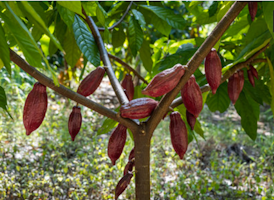
Information: Cocoa trees are found in the tropical rainforests of
Mexico, Central and South America. The cocoa tree produces a large
pod-shaped fruit that grows directly from the trees trunk or
branches. Each pod can contain up to 50 seeds. The seeds are roasted
and processed to make cocoa which is then made into chocolate.
A favorite drink of the Aztec and Inca Kings was cocoa seeds and
spices (such as cinnamon). The Spanish explorers took the cocoa
powder back to Europe. The Spanish sweetened the cocoa powder with
sugar. The Swiss added milk to the cocoa powder and created milk
chocolate. The English, in the 19th century, developed solid
chocolate and created the chocolate candy bar.
Need: 3 cups milk, 1 cup cocoa, 1 1/2 cups sugar, 3 teaspoons
vanilla, whipped topping, 3/4 teaspoon cinnamon.
In a saucepan, heat milk until hot, but not boiling. In a small bowl
mix the cocoa, sugar, and cinnamon. Add 2 tablespoons hot milk to the
chocolate mixture, stir until smooth. Blend the chocolate mixture
into the remaining milk. Remove from heat, add vanilla, and beat with
a wire whisk until frothy. To serve, add a spoonful of whipped
topping to each cup of chocolate. Makes about 3 quarts.
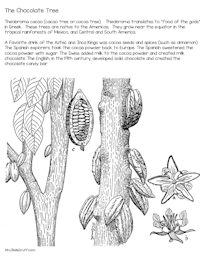
Cocoa Flower Color Page
Cocoa Seed Pod Color Page
Cocoa Tree & Flower Color Page
Fruit Surprise
Need: 2 bananas, 2 cups orange juice, 2 cups pineapple juice, 2 cans
lemon-lime soft drink, 2 pints lemon sherbet, 1 can Mandarin oranges,
1 can crushed pineapple
Send note home or post a sign up sheet with the ingredients listed
for parents to send.
Puree 2 soft, ripe bananas in a blender. Add the orange juice,
crushed pineapple, oranges, and pineapple juice. Blend. Before
serving add the lemon-lime soft drink, and mix well. Put a spoonful
of lemon sherbet in each glass, and fill with punch. Makes about 2 quarts.
*Math
Snack Graph
Bring in rain forest fruits such as mango, guava, papaya, and
coconut. Have the children try each of the different fruits. Ask each
student to draw a picture of their favorite one. On the board, make
rows of the different fruits. Tell students to put their picture in
the respective row. After all students have finished, discuss the
different qualities of the picture graph. Ask students: Which was the
favorite fruit? Which was the least favorite? And so on.
*Sites to See
Rainforest
Resources/Facts
Amazon Interactive
Learn about the people and geography of the Ecuadorian Amazon.Plan
and manage a locally-controlled ecotourism project. Can you make
ecotourism sustainable?
Earthwatch-Curriculum Ideas & Lesson Plans(grades elem-high)
|