Austria -- School-Age
Austria
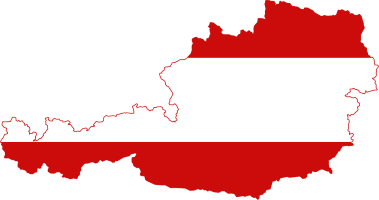
Things to Know
Republic of Austria
Federal Republic
Capital: Vienna
Vienna is situated in the East of Austria away from the Alps.
The Hapsburg dynasty dominated central Europe for close to 700 years from the 13th to the 20th century.
Official Language: German
Currency: Euro
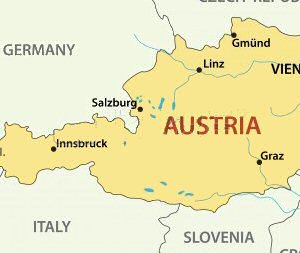
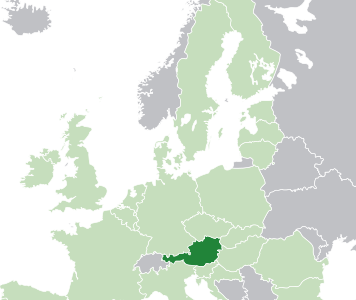
Austria is a pipe-shaped, landlocked country in Europe.
Animals
Lippizaner (Lipizzaner)
Pure white horse, named after its place of origin in Lippiza, Slovenia. They are trained at the Spanish Riding School of Vienna.
Ibex (a mountain goat with huge curved horns) and chamois (horned goat antelope related to goats but having antelope-like features).
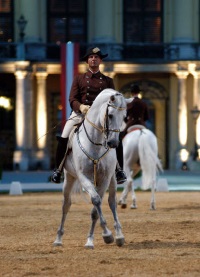
Lipizzan Stallion, Schönbrunn Palace
Explorers
Mary Kingsley (1862-1900) The greatest of all women explorers.
Sir
Richard Francis Burton (1821-1890)
Explorer, linguist, soldier, spy, and more.
John
Speke (1827 - 1864)
Discovered Lake Victoria the largest source of the Nile River.
Dr. David Livingstone
(1813-1873) Explored the interior of Africa.
Isabelle Eberhardt
(1877-1904) was an explorer who lived and traveled extensively in North Africa.
Climate
Cold winters with frequent rain in lowlands and snow in the mountains; cool summers with occasional showers.
Land
The two best known features of the Austrian landscape are the Alps and the Danube River. In the west and south is mostly mountains (Alps); along the eastern and northern margins is mostly flat or gently sloping land. The Alps cover 62 percent of Austria's total area.
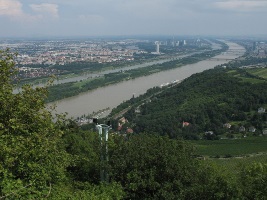
The Danube river in Vienna
The Danube River is the second longest river in Europe (The Volga River in Russia is the longest river in Europe). The Danube River has its source in southwestern Germany and flows through Austria before emptying into the Black Sea. It is the only major European river that flows from west to east. The Danube River's importance as an inland waterway was enhanced by the completion in 1992 of the Rhine-Main-Danube Canal in Bavaria, which connects the Rhine and Main rivers with the Danube and makes possible barge traffic from the North Sea to the Black Sea.
Plants
Nearly half of Austria is forested, mainly with oak and beech at low altitudes; at higher elevations conifers predominate. Trees yield to Alpine meadows at just over 2000m and orchids, edelweiss and poppies become quite common.
Music
Austria has sometimes been called "the land of music."
Sängerknaben--World fame as the Vienna Boys' Choir.
Composer Franz Joseph Haydn - Regarded as the father of the symphony.
Johann Strauss the Younger is known as the Waltz King because of the many waltzes he wrote. Listen to the famous Strauss waltz, ""The Blue Danube".
Wolfgang Amadeus Mozart (1756–91), a native of Salzburg, is considered one of the world's greatest composers.
Twinkle Twinkle Little Star, Baa, Baa, Black Sheep, and The Alphabet Song all share the same tune from an old French melody titled "Ah! Vous Dirai-Je, Maman" ("Shall I tell you, Mother?"). Mozart composed a set of 12 improvisations on "Ah! Vous Dirai-Je, Maman. The words to the song are from an early nineteenth-centry English poem, “The Star” written by Jane Taylor."Twinkle, Twinkle, Little Star" words.
Let's Go Mozart! Teacher Resource Kit available for download as a pdf.
Twinkle, Twinkle, Little Star color page
Biography on Mozart for children (read online)
Video
Yodel
The Internet Yodel Course
Learn the noble art of yodeling in 10 free lessons.
Read
Baroness Bertha von Suttner
Nobel Peace Prize winner.
Artist - Hundertwasser
Friedensreich Hundertwasser was born in Austria in 1928. He was one of the most important artists an architects during the 20 century.
Lollipop trees, in the style of Hundertwasser
Sponge paint background then add lolipop trees.
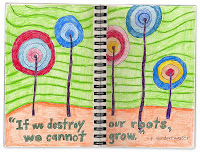
Hundertwasser Flowers (Lolipop Trees)
Wavy lines and lolipop trees.
Recommended Books

Hundertwasser for Kids: Harvesting Dreams by Barbara Stieff

Hundertwasser: Create Your Own City by Prestel Publishing (Editor)
Artist - Klimt
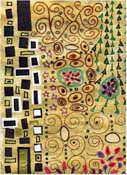
Building a Klimt
Children follow called out directions to create a picture in Gustav Klimt patterns. NOTE: Some of Gustav Klimt's works may not be suitable for young children be sure to review any of his works before showing to children.
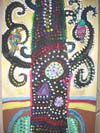 Tree of Life-Klimt
Picture done in layers in the style of Gustav Klimt's Tree of Life painted in 1909.

Klimt and His Cat by Berenice Capatti
Children's Music Review
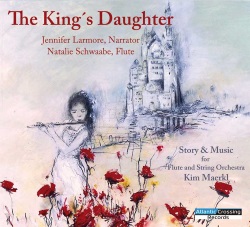
The King's Daughter
Kim Maerkl (Author/Composer), Jennifer Larmore (Narration), Natalie Schwaabe (Flute)
A spellbinding story and music that tells of Sophia's greatest joy, playing the flute. Sophia is enchanted with the gift of the flute from her aunt. She occupies all her time learning to play the flute and her music grew more beutiful each day. Sophia's father, the king, does not apporve of Sophia play the flute like a servant. Sophia then plays her flute unde the linden tree with the wind carrying her songs on the wind.
An enchanting story of Sophia'a great passion for the flute, following her dream with great risk and determination, and learning why the king truely disappoves of her playing music. An enchanting story with beautiful flute music that wonderfully enhances the story. Enchanting!
Availible at iTunes
Sites to See
Powder Skiing online jigsaw puzzle.
Ski Time online jigsaw puzzle.
Fun Facts
History of PEZ
PEZ was created in 1927 by Edward Haas in Vienna, Austria.
Austrians pronounce their country's name Österreich (Ost-rike), which means in German "kingdom of the east."