The American Bald Eagle -- School-age
American Bald Eagle
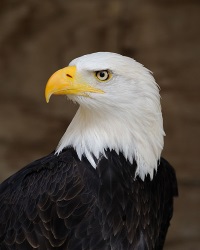

Things to Know
The bald eagle has been the national symbol of the United States since June 20, 1782.
The bald eagle is an endangered species and is the only unique eagle found on the North America continent. The bald eagle gets its name from an old English word, “balde” which means “white,” not “hairless.” You can find bald eagles in every U. S. state except Hawaii. 80% of the bald eagles in the United States are found in Alaska.
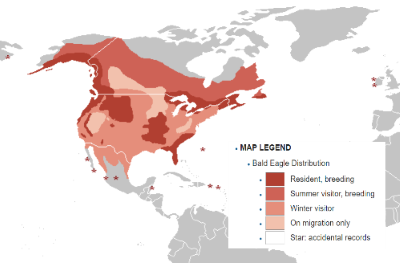
Bald Eagles are one of the largest birds in North America. Adult eagles generally weigh between 7 to 15 pounds and have a wing span of 6 to 8 feet. The tops of the bald eagle’s legs have feathers. Females are about 1/3 larger than males.
A recording of a Bald Eagle at Yellowstone National Park.
Video
Family
Eagle is the name for both male and female members of the species. In many bird species, it is easy to tell males from females because the plumage is different. This is not so with eagles. Female eagles are larger than male eagles.
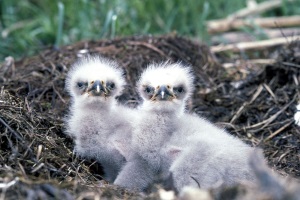
Baby eagles are mottled brown and white. The female lays 1 to 3 eggs. The eggs take between 1 to 1 1/2 months to hatch. Both the male and female will take a turn of sitting on the eggs. After hatching both the male and female feed the hatching's until they learn to fly. Eaglets are capable of flying at 10-12 weeks.
The distinct white head and tail of the mature bird is developed between 4 and 6 years of age. The beak and eyes turn yellow between 4 and 5 years of age, and are brown prior to that time. Their eyesight is very powerful, at least 3 to 4 times greater than that of humans.
Video
Migration
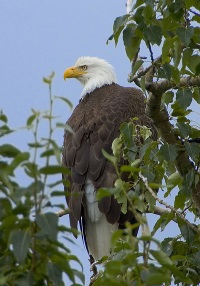
Not all eagles migrate. Many bald eagles will remain in a place over the winter where water remains open and food is available. The bald eagles migration begins in the fall when northern lakes and rivers freeze over. They move south to areas with water and food sources. Young eagles migrate earlier than their parents.
Wings
A bald eagles wings are long and broad, making them effective for soaring. When migrating, eagles seldom flap their wings; rather, they use thermal updrafts. Thermal updrafts are rising currents of warm air, and updrafts are generated by terrain, such as valley edges or mountain slopes. Soaring enables bald eagles to conserve energy. Long-distance migration flights are accomplished by climbing high in a thermal updraft and then gliding downward to catch the next thermal.
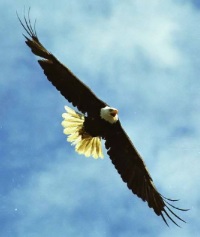
The flight speed of a bald eagle ranges between 36 and 44 miles per hour. Their long descending dive speed is estimated at 50-75 miles per hour.
Diet
Bald Eagles live near large bodies of open water such as lakes, marshes, seacoasts and rivers, where there are plenty of fish to eat and tall trees for nesting and roosting. Bald Eagles are carnivores (meat-eaters) and hunt during the day. Eagles feed mainly on fish, but they also eat anything that can be caught easily or is found dead. But, they cannot lift more than four pounds.

Eagles have a food storage area below their chin called a crop. It is an extendable part in the esophagus that is used for the storage and softening of food and and controls the flow of food through the digestive tract. When eaglets have a full crop it can be seen bulging out. Adult eagles can store up to two pounds of food in their crop.
Eagles are birds of prey, or raptors, they hunt for a living usually while on the wing, are meat eaters, use their feet instead of their beak to capture prey. They have keen eyesight, a sharp hooked beak, and powerful feet with curved sharp talons.
Predators
Things to Do
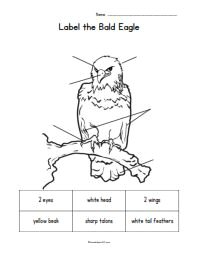

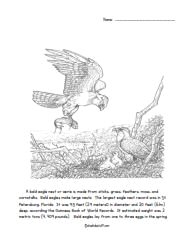
Bald Eagle
Use construction paper to make a bald eagle.
The Bald Eagle An Educational Activity Guide {U.S Army Corps of Engineers}
Includes classroom activites - build an eagle wing.
Recommended Book

My Little Book of Bald Eagles
by Hope Irvin Marston
A wonderful story of a bald eagle family from nest building to baby eaglets. Follow as the baby eagles learn their first lessons of flight and grow into adult bald eagles. beautifully illustrated.