Legend of the Bluebonnet
Art
Make A Doll
Make a doll like the one made for She-Who-Is-Alone. Use scraps of fabric, yarn, etc., to create the doll.
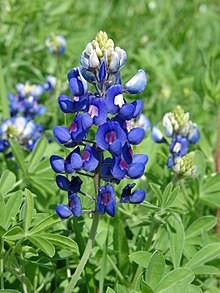
A Bluebonnet
Our class of 3's paints a bluebonnet as a follow-up
activity to reading "The Legend of the Bluebonnet".
The teacher lightly sketches an elongated oval (our shape of the month) and the children use the eraser end of a pencil to dot the entire area with blue tempra. They then add a tip of white and blend it down a short distance. The teacher or children can add a bit of green for stems and leaves or the "bluebonnet" can be cut out and placed on a bulletin board to make a field of bluebonnets. Contributed By: Phyllis M.
Writing
Create A Legend
Write a legend about your state flower or another flower that you like.
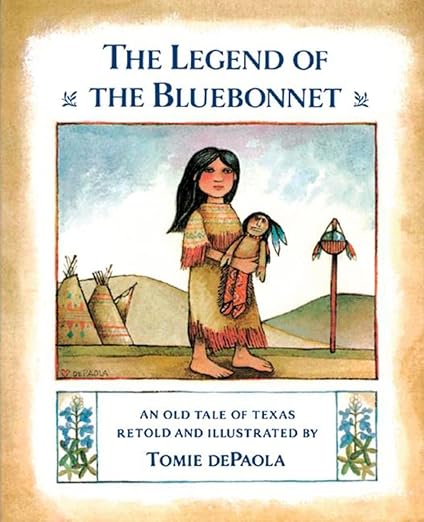
The Legend of the Bluebonnet
by Tomie dePaola
The Legend of the ____
After reading the story aloud, lead a discussion on what a sacrifice is. Have the children brainstorm possible sacrifices that they could make, or sacrifices that people have made for them. Next, have the children pretend that they are She/He Who is Alone. Ask the children what they would sacrifice in order to save their people. Why would this be a sacrifice for them . . . why would this be special?
Now have the children decide what the flower would look like that came from the ashes of their sacrifice. Remind them that the Bluebonnet came from the Bluebird feather on the doll that the little girl sacrificed.
Display the flowers and legends in the hall for all to see.
Science
Liquids in Plants
Need: 2 tall glassed, 2 celery stalks with leaves, water, food coloring
Put water in both glasses. Add food coloring to one of the glasses. Place a stalk of celery in each glass. (An adult should cut the bottom inch off each celery stalk just before the children place it in the water).
Leave the celery in the glass overnight. The next day, have the children examine the leaves of the celery for evidence of color. Cut each group's celery stalks in cross sections, and have the children compare the cross sections of the celery that was immersed in colored water with that of the other celery.
Dried Plants
Need: white cornmeal, borax, glass jar, flower or planet, cup with a pouring lip
A head of time mix 6 parts of white cornmeal with 1 part of borax.
Encourage children to find flowers or plants that they would like to save. Assist the children with the following steps.
Fill the bottom of a glass jar with the cornmeal-borax mixture.
Place the flower or plant in the jar, stem up.
Slowly pour more of the cornmeal-borax mixture around the flower or plant. Make sure the entire flower is covered by the mixture.
Wait 2 weeks for the flower to completely dry.
Gently pour the drying mixture out of the jar, and remove the flower. Children can make art projects with their plants or bouquets of dried flowers to give as gifts.
Things to Do

Tomie dePaola website.