Jamaica -- School-age
Jamaica
Official Name: Jamaica
Government Type: Parliamentary Democracy
Capital: Kingston
County's inhabitants: Jamaican
Abbreviation: JM, JAM
Currency: Jamaican Dollar (JMD)
Official Language: English
Most Jamaican's will speak English patois {patwah), a language that is British English with West African influences.
Religion: Christian
Population: 2.95 million (2022)
Ethnic Groups: Black 92.1%, mixed 6.1%, East Indian 0.8%, other 0.4% (2011)
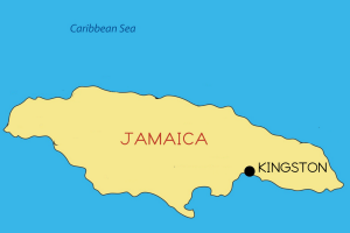
Jamaica is a mountainous island country located in the Caribbean Sea that lies south of Cuba and west of Haiti. It is the third-largest island of the Greater Antilles and the Caribbean at 4,320 sq mi (10,831 sq km).
Jamaica is located about half-way between North and South America. It is part of the North American continent.
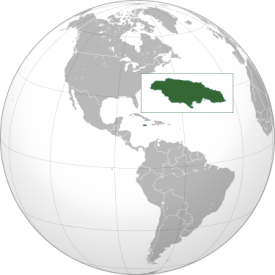
History
The Arawak Indians lived in South America and on islands in the Caribbean Sea. The original inhabitants of Jamaica are believed to be the Tainos, an Arawak subgroup.
In 1494 Christopher Columbus landed in Jamaica.
After Christopher Columbus arrived on the island the Spanish colonized the island. Columbus and his crew, and later the Spaniards carried with them the European diseases of measles and smallpox that nearly killed all of the Tainos.
Who were the Tainos? A virtual exhibition tour.
In 1655 the island of Jamaica became an English colony when the British captured it from the Spanish.
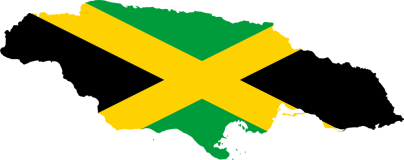
The Jamaican flag was raised at midnight on August 5, 1962 as the British flag was being lowered. August 6, 1962 is Jamaica's Independence Day. Jamaica's political independence (remained part of the British Commonwealth) from over 300 years under British rule.
Flag of Jamaica
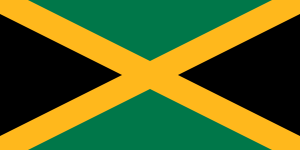
The colors of the Jamaican flag are black, green, and gold.
The official interpretation of the Jamaican National Flag
“The sun shineth, the land is green and the people are strong and creative” is the symbolism of the colours of the flag. Black depicts the strength and creativity of the
people; Gold, the natural wealth and beauty of sunlight; and green, hope and agricultural resources.
Jamaican Symbols
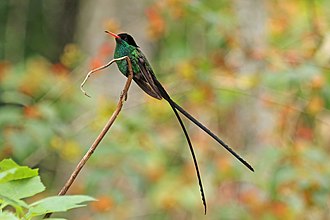
The Swallow-tail Hummingbird (Doctor Bird is Jamaica's National Bird) The "Doctor Bird" lives only in Jamaica and is one of the most outstanding of all the species of humming birds.
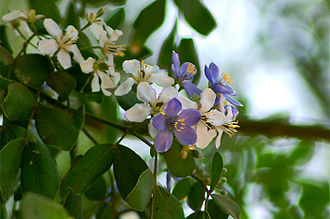
The Lignum Vitae (Guiacum Officinale) is a small slow growing tree that is native to Jamaica.
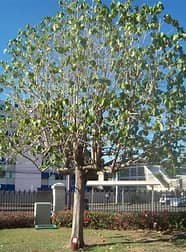
The national tree of Jamaica is the Blue Mahoe (Hibiscus Elatus). It is native to the island of Jamaica. It often grows up to 20 meters (66 ft). The trunk is straight, leaves are broad green, and hibiscus-like flowers that change colors as it matures - from bright yellow to orange red to crimson. The inner bark is used to make ropes and cords. A hard wood that is used in the making of cuatros (a type of lute) and furniture. When polished there are blue-green streaks in the wood.
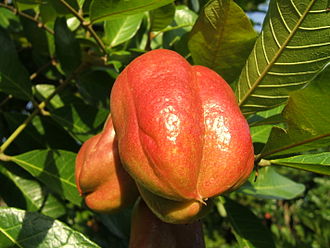
The Ackee is the national fruit of Jamaica. This tree is not native to Jamaica, it has a historical association in that it was imported to the island from West Africa probably on a slave ship. The Ackee tree grows about 10 meters tall and has pear-shaped fruit.
Animals
329 bird species have been found in Jamaica.
Of them, 28 are unique bird species in Jamaica. The "Doctor Bird" lives only in Jamaica and is one of the most outstanding of all the species of Humming Birds. Also abundant are parrots, cuckoos, and green todies.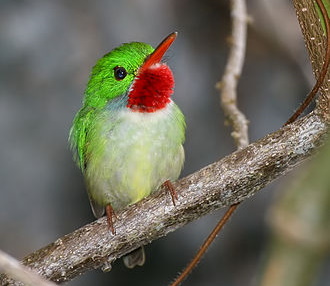
Jamaican Tody
There are nine species of snakes known in Jamaica; all of them are non-poisonous. The largest is the Jamaican boa, or Yellow Snake. Also abundant are bats, mongooses, frogs, lizards, and crocodiles.
Jamaican Iguana
The Hellshire Hills provide the last known habitat for the rediscovered (1990) Jamaican Iguana.
Indian Coney (large brown rodent) The only endemic terrestrial mammal, the Hutia or Indian Coney. The Indian Coney lives in holes in the ground and feeds on plants.
There are over 133 species and subspecies of butterflies in Jamaica. The most famous is the giant swallowtail butterfly one of the largest butterflies in the world with a fore wing size of 3 inches.
Explorer
On May 5, 1494 Christopher Columbus landed in Jamaica.
Land
Climate
Tropical; hot, humid; temperate interior (from December to March colder winds reach the island.
The island of Jamaica consist of mountains inland to beautiful beaches on the coast. In the east is the most rugged area and the highest elevations. The Blue Mountains rise to 7,402 feet at Blue Mountain Peak , the island's highest point.
The Coconut Palm is not native to Jamaica. Nor are sugar cane, bananas, mangoes, breadfruit or bamboo. They were all brought to the island at various stages in its history. The original Arawak inhabitants lived mainly on corn, fish and yams.
Three thousand species of plants grow on the Jamaican island, and 27 percent of them are found nowhere else on Earth. Agriculture products: sugarcane, bananas, coffee , citrus, potatoes, vegetables; poultry, goats, milk.
Jamaica Is Famous For
Jamaica is home several world-renowned sprinters, including the fastest runner in the world, Usain Bolt.
Port Royal a perfect place for pirates.
Reggae is a popular musical genre originating from Jamaica. Bob Marley (1945-1981)made reggae music very popular world wide.
Jamaican Products
Blue Mountain Coffee is grown in the Blue Mountains, the highest mountains in the Caribbean.
The top exports from Jamaica are inorganic chemicals, refined petroleum oils, liquor, vinegar, coffee, tea, spices, fish, cereal, then a subgroup of yams, sweet potatoes and artichokes.
Things to Do
Jamaica Flag color page
Recommended Books

The Chalk Doll
by Charlotte Pomerantz
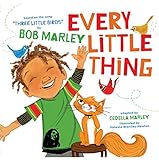
Every Little Thing
by Bob Marley
See Also