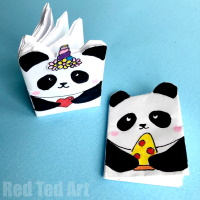
The giant panda is a bear. There is much discussion about whether
they are bears, raccoons or their own species. They share some
features of bears and some of raccoons. The giant panda does not
hibernate during the winter. Due to their leaner diets, they do not
build up the excess fat needed to hibernate. They also live in a
habitat zone where food is available on all year round. The panda is
classified as a bear.

Giant pandas are classified as carnivores (meat-eating mammals).
While bamboo represents 99% of their diet they have also been known
to eat fish, pikas, rodents, vines, irises, crocus, mushrooms and
rice grass. The panda assumes a sitting position to eat. Their unique
forepaws have an enlarged wristbone that they can flex like a thumb.
This allows them to direct bamboo stalks to their mouths where they
strip off bites with their incisor teeth. About 12 hours each day are
spent feeding and they consume 12-15% of their body weight each day.
They drink water usually just once a day.
Giant panda bears have a massive head, heavy body, short tail,
rounded ears and plantigrade feet (both heel and toe make contact
with the ground when walking in a manner similar to humans). They
walk through the bamboo forest with a rolling gait. Unlike many other
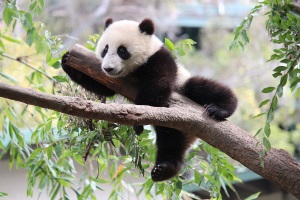
bears, pandas do not walk on their hind legs and only climb trees
when threatened. Pandas area generally solitary animals, even
avoiding contact with others of its kind.

Giant pandas have very good eyesight. Most bears have round pupils.
The giant pandas pupils are vertical slits like cat's eyes. The
Chinese people call the panda "Da Xiong Mao," which means
"giant bear cat" in Chinese.
The Panda is a large mammal about 5-6 feet high. They will weigh up
to 350 pounds with the males weighing about 10% more than females.
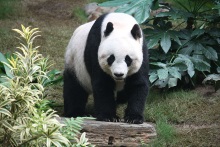
The ears, eye patches, legs and shoulder band are black while the
rest of the body is white. This black-and-white coloring may
camouflage the panda in the snowy environment. The fur of the giant
panda is thick and coarse. It consists of a coarse outer layer and a
very dense, wooly-like underfur. To the touch, the fur feels oily and
this oily substance protects and insulates the panda from the cool
and damp climate it lives in.

Female pandas are called sows, males are called boars, and the young
are called cubs. Female giant pandas mature at about 5 to 7 years of
age. Mating begins in the spring with the panda bears attracting each
other with calls and odors..
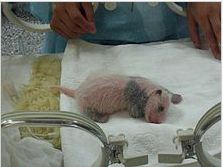
When cubs are born they are blind and pink in colour with little
white hair. Their coat begins to darken about a month after their
birth. The cub when born is as big as a common mouse at about 28
inches long and weighing about 6 ounces (85-100gm)

Panda cubs cry when they are hungry. They start eating bamboo when
they are about 6 months old and are fully weaned from their mother at
about 9 months. At one year of age, the cubs normally weigh about 75
pounds. Panda cubs stay with their mother for one to two years. They
are fully grown in 2-4 years.
The giant panda is a black and white bear that is on the verge of
extinction. There may be only a little more than 1000 pandas
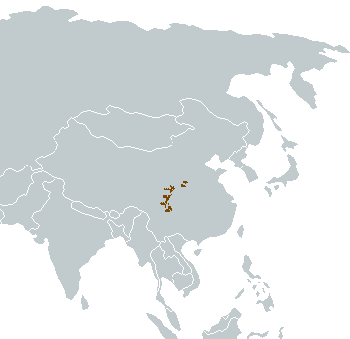
remaining in very fragmented and isolated areas. Giant pandas live
only in the mountain ranges in the provinces of Sichuan, Shaanxi, and
Gansu in Western China. They inhabit damp, misty forests of bamboo
and conifers at altitudes of 4,000-11,500 feet (2,600 to 3,500 m).
Often the area is snow bound. They migrate higher in the summer,
lower in the winter and prefer areas that are undisturbed by human
activity and with access to clear mountain streams.
.
The panda is a symbol of peace in China. Humans are the giant pandas
only enemy. The Chinese government has taken steps to protect these
endangered animals.
The color pages will open in a new window.
Giant Panda color page
Giant Panda mom and cub
color page
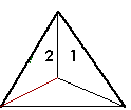
Panda Triangle Diorama
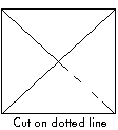
Fold a 9" by 9" construction paper or poster board. Fold
the paper-top left corner to bottom right corner open, then fold top right
corner to bottom left corner.
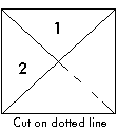
Open and cut from the bottom right corner to the center.

In the area 1 and 2 draw a bamboo forest.


Overlap and staple the two cut bottom triangles. Stand the triangle
diorama up. Add pandas made from clay, playdough, or paper.