Venezuela -- School-age
Venezuela
Official Name: Republica Bolivariana de Venezuela
Bolivarian Republic of Venezuela
Government Type: Federal Republic
Capital: Caracas
Caracas is located under the Avila, a mountain that reaches 2600 meters (7800 ft.)
County's inhabitants: Venezuelans
Abbreviation: VE, VEN
Currency: Bolivar
Official Language: Spanish (official), various indigenous languages in the remote interior.
Religion: Roman Catholic 96%, Protestant 2%
Population: 28.22 million (2023)
Ethnic Groups: mestizo 67%( a person of mixed European and American Indian ancestry), white 21%, black 10%, Amerindian 2%
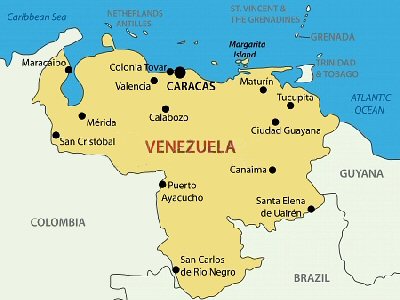
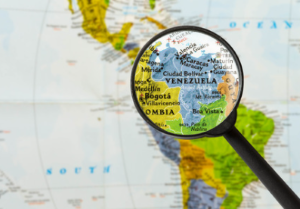
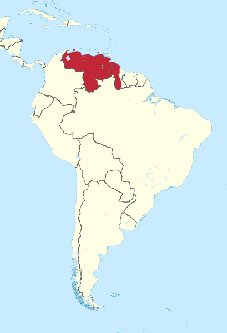
Venezuela is located on the northern coast of South America. The northeast borders the northern Atlantic Ocean. .
The Federal Republic of Venezuela is the sixth largest country in South America.
History
In 1498, on his third trip to the Americas Christopher Columbus set foot on the American mainland at Paria Peninsula in present-day Venezuela. Columbus claimed it for Spain. Other explorers arrived.
Amerigo Vespucci was part of the Alonso de Hojeda expedition of Venezuela in 1499. The explorers saw villages that reminded them of Venice. Local people had built houses on stilts along Lake Maracaibo. It is believed that the region was named Venezuela (which means Little Venice) by Americo Vespucci, later becoming Venezuela.
Venezuela was controlled by Spain beginning in 1522. In 1830, Venezuela become an independent country with Caracas as its capital.
Simon Bolivar
The man who won independence for Bolivia, Panama, Colombia, Ecuador, Peru, and Venezuela.
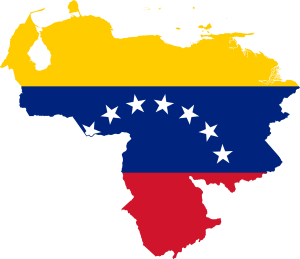
Flag of Venezuela
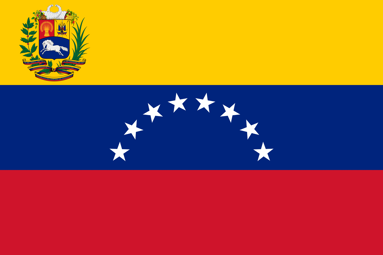
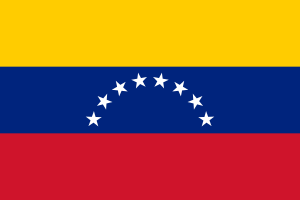
Venezuela has a history of a variety of flags used over time. The current National Flag of Venezuela was officially adopted on March 26, 2006.
In 1811 Venezuela attained independence and adopted a flag containing yellow-blue-red stripes. Seven five-pointed stars represents the original provinces on the flag of Venezuela. In 1930 the stars were arranged to form an arc in the center of the flag. In 1954 the coat of arms was added to the upper left corner of the flag. The flag of Venezuela underwent minor changes in 2006, an eighth star was added to honor the national hero Simón Bolívar, it represents the historical province of Guayana.Venezuela Country Profile Video
Animals
"Venezuela has 1,417 bird species, 351 mammals, 315 species of amphibians, and 341 reptiles," states the World Atlas.
Spectacled bears are South America's only bear species. It is a medium-sized by bear standards, but they are the second-largest land mammals in South America.
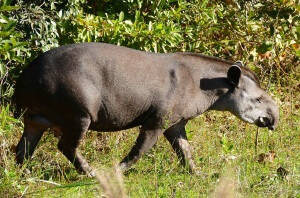
Tapirs are the largest land mammals in Venezuela. It can weight 500 to 800 pounds.
Climate
Because of its proximity to the Equator, Venezuela experiences few climatic variations. There are really only two seasons: dry and wet. The dry season lasts from December to April, the wet one from May to November. The average temperature is about 27C, but cooler temperatures prevail at higher elevations.
Land
In the north:
White-sand beaches fringed with coconut palms line the Caribbean coast.
In the east:
The eastern region of Venezuela consist of beaches, interesting towns and villages.
In the west:
The Trujillo a small state called "The Portable City" for having changed its location several times, is the door to the Andean region.
In the south:
In the south-east is the Gran Sabana plateau (the Great Savannah), with its strange flat-topped mountains (tepuis. The Gran Sabana is the larger part of the immense . Situated on the Guayana Plateau, to the South East of Venezuela, it is one of the oldest geological rock formations in the world. Mount Roraima is the tallest tepui in Venezuela.
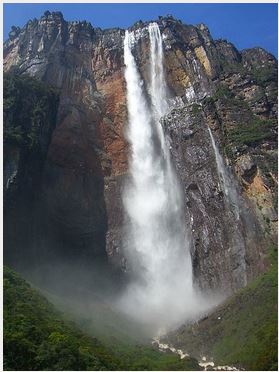
To the south, the Guiana Highlands north of the Amazon rainforest. Angel Falls the world’s highest waterfall is in the Guiana Highlands. Angel Falls is the world's highest and longest uninterrupted waterfall, with a height of 979 m (3,212 ft).
Video
Plants
The plant life of Venezuela is diverse, ranging from grasslands, to desert cacti, and the rainforest jungle.
Make
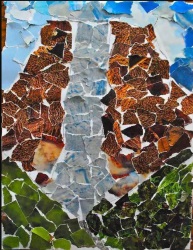
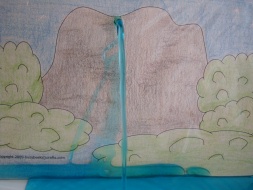
Paper Waterfall
Two versions of the art project, with one being an easy version.
Recommended Book


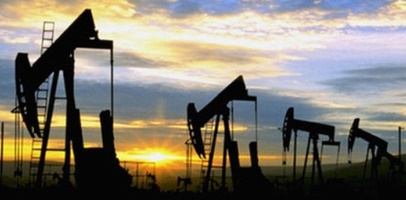
Oil, mangoes, and Angel Falls. International beauty contest winners and the golden legend of El Dorado. Wander inside this beautiful book to learn the ABCs of what makes Venezuela a South American jewel.